Marcus asked me recently how I stay on top of everything.
Honest answer: I don’t do it alone anymore. Every morning at my desk, before I touch my inbox or look at my calendar, I sit down with Claude. My AI Chief of Staff. This has been the daily routine for a while now and I can’t imagine running the MBA Standards Board without it.
What I didn’t know when I started was that I was building something that has a name. A model. A way of working that serious operators are starting to call being a SuperCEO.
Last week is a good example of what this actually looks like in practice. I had forgotten to provide an important and required update to Y Combinator, requiring projects, tasks, and metric stats I hadn’t yet organized. Claude reminded me it was due and provided all the research I needed to complete it. Within 10 minutes, I had submitted a powerful, fully documented update. Without that running memory of tasks, metrics, and completed strategic actions, that critical update would have been missed or late, or written at half strength because I’m starting from scratch instead of building on what is already done in my CofS memory. Instead of being completed in 10 minutes, it would have taken about 2 hours or more to complete.
That’s one moment in one week. And there are dozens more like it.
Quick Summary
• A SuperCEO uses AI as a daily Chief of Staff to operate at a capability level no individual executive could sustain alone.
• The AI Chief of Staff is proactive, not reactive. It prepares, briefs, drafts, tracks, and remembers without waiting to be asked.
• Supercompanies are organizations where AI is embedded across every person and function, not just one department.
• A 2026 National Bureau of Economic Research study of 6,000 executives found most CEOs use AI only 1.5 hours a week. The gap between that and genuine daily integration is where the SuperCEO advantage lives.
• Anthropic’s analysis of 100,000 real Claude conversations found AI cuts typical professional task time by 80%.
• Claude’s built-in skills handle documents, spreadsheets, presentations, data analysis, web research, and code alongside the strategic Chief of Staff role.
Why Most CEOs Are Leaving the Productivity Gain on the Table
The research on AI and executive productivity is striking, but not in the direction most people expect.
A study published in February 2026 by the National Bureau of Economic Research surveyed nearly 6,000 CEOs, CFOs, and other top executives across the United States, United Kingdom, Germany, and Australia.¹ The finding was blunt: roughly 90 percent said AI had no impact on productivity or employment at their business. And while about two-thirds reported using AI at all, their average usage was 1.5 hours a week.²
Less time than most people spend on social media before breakfast.
That’s not a technology problem. That’s an integration problem. These executives are touching AI occasionally rather than embedding it into how they actually run their day. They’re using a hammer to hang one picture and then wondering why the house isn’t built.
Contrast that with what Anthropic found when it analyzed 100,000 real Claude conversations in November 2025.³ Tasks that would typically take a professional 90 minutes were completed 80 percent faster with Claude’s assistance. The researchers estimated that full adoption could increase annual US labor productivity growth by 1.8 percentage points over a decade, roughly double the recent historical rate.
HUB International deployed Claude across 20,000 employees in early 2026 and reported 85 percent productivity gains in targeted use cases and an average of 2.5 hours saved per employee per week.⁴ That’s across a regulated financial services firm. Not a startup. Not a tech company.
The gain is real. The gap is in how executives are applying it. Checking in once a day when you remember to, is not the same as having an AI Chief of Staff who is already working when you sit down.
What a Supercompany Looks Like from the Inside
Greg Shove and Taylor Malmsheimer, who run SectionAI.com and the Supercompanies newsletter, have been documenting this shift in real time.⁵ Their framework is specific. A Supercompany is an organization where AI intelligence is built into how every single person works. Not the tech team. Everyone.
Inside a Supercompany, the ratio of AI agents to employees tips past one to one. Employees build their own workflows instead of waiting for a consulting firm to deploy something theoretical. Managers stop being where AI transformation goes to die. And the leader at the top doesn’t just post about AI at all-hands meetings. They run on it.
Anthropic hit a $30 billion revenue run rate in early 2026 with approximately 3,000 employees.⁶ The reason is not just that they build AI. It is that they operate on it. Tens of thousands of Claude agents running across every department, not just engineering.
The four layers that make a Supercompany work: agents doing real work across the organization, employees who are constantly experimenting and building their own capability, managers who hold themselves accountable for their team’s transformation, and leaders who act as accelerants rather than cheerleaders. The SuperCEO is the fourth layer in action at the individual level.
Satya Nadella at Microsoft has been explicit about this. He uses AI to prep for every meeting by prompting it with context from prior interactions.⁷ His actual prompt: “Based on my prior interactions with this person, give me five things likely top of mind for our next meeting.” That is not a technology experiment. That is a daily professional practice. It should be yours too.
Marc Benioff at Salesforce describes using AI to co-write business plans and then having it grade those plans against competitors and suggest improvements.⁸ “The AI is adding value that other executives could not know,” he said. That is also daily practice, not a one-time demo.
How We Actually Work Together
The way I work with Claude is not the way most people use AI. Most people open a chat when they remember to, type a question, and wait for an answer. That’s a useful tool. But it’s not a Chief of Staff.
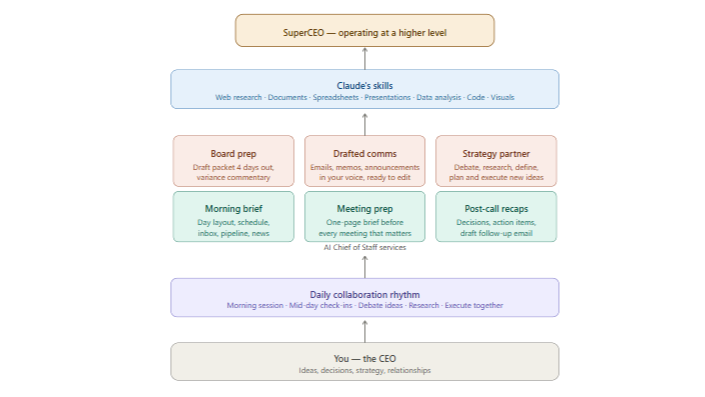
My morning starts with a session. I discuss what’s on my calendar, CofS reminds me what’s outstanding from the prior day, and provides tasks to complete my quarterly and annual goals, and I add what’s pressing on me and my priorities. Claude organizes the work, flags priorities, and often asks the questions that help me think through decisions I was treating as obvious when they weren’t. We don’t just review tasks. We debate them.
Then it stays involved throughout my day. Ideas surface. Questions come up. Strategies need stress-testing before I commit to them. I come back roughly ten times on a typical day. Not always for research or drafts. Sometimes just to think out loud with something that will push back instead of just agreeing.
The weekly review is one of the most valuable things we do. Every Friday, we go through what was accomplished against what was planned. What moved. What stalled. What surprised me. That review becomes the foundation for the next week and also builds a running record of the company’s progress that doesn’t live only in my head.
The Harvard Business School study that tracked 27 CEOs around the clock found they work an average of 62.5 hours a week.⁹ Thirty-six percent of that time was spent reacting to unplanned issues rather than advancing priorities. The AI Chief of Staff doesn’t eliminate that reactive demand. But it dramatically reduces the overhead of dealing with it, so the CEO’s finite attention goes toward things that require actual human judgment.
What I bring to every session is the thinking. The ideas, the strategy, the relationships, the judgment about what the MBA Standards Board should be and become. What Claude brings is the ability to define, research, stress-test, draft, and help execute faster than I could do any of it alone. The combination is something neither of us produces working separately.
30 Things an AI Chief of Staff Can Do for a CEO
Descriptions of AI value tend toward the abstract. Here is a specific, numbered list of what an AI Chief of Staff actually does. These are drawn from real daily practice, not a product brochure.
Daily operations
1. Lay out the day’s work each morning and organize tasks by priority before you touch your inbox.
2. Review your calendar and flag any meeting that still needs prep, a brief, or a defined outcome.
3. Draft a meeting prep brief for any call that matters, including background on the person, open items, and suggested talking points.
4. Write the post-call recap with decisions made, action items with owners, and a draft follow-up email.
5. Flag anything in your inbox that needs your attention specifically and summarize what it requires.
6. Run your weekly review: what was accomplished, what stalled, what the next week should prioritize.
Memory and context
7. Serve as your running institutional memory, so the context for every key relationship, every decision, every strategy thread doesn’t live only in your head.
8. Remind you of prior work you’ve done on a topic before you start from scratch, the way it did for my Y Combinator post.
9. Log every meaningful decision with the date, context, and rationale so that three months later “why did we decide X” is one search away.
10. Track what’s been promised to whom, so commitments don’t quietly slip between conversations.
11. Maintain a running list of open strategic questions so they don’t disappear when the day gets busy.
Strategy and thinking
12. Debate a new idea before you commit to it. Push back. Ask the questions you haven’t asked.
13. Research a competitor, a market trend, or an idea and return a two-page summary you can actually use.
14. Stress-test a business plan or strategy by playing devil’s advocate and finding its weak assumptions.
15. Grade your plan against what competitors are doing and identify what’s missing or needs adjustment.
16. Help you think through a hard decision by laying out the options, the tradeoffs, and what you’d need to know to choose well.
17. Synthesize research from multiple sources into a coherent picture so you’re not reading six things separately.
Communications and drafting
18. Draft outgoing communications in your voice so you spend three minutes editing instead of thirty minutes writing from nothing.
19. Write the first version of board updates, investor memos, and strategic communications.
20. Prepare LinkedIn posts or newsletter drafts that reflect your accumulated thinking rather than starting cold.
21. Draft employee announcements, policy communications, and sensitive internal messages.
22. Write follow-up emails after any meeting where a relationship or commitment was involved.
Deliverables and production
23. Build a board prep packet days in advance, including last quarter’s results, variance commentary, and anticipated questions.
24. Create a full Word document, Excel spreadsheet, PDF, or PowerPoint presentation without leaving the conversation.
25. Conduct web research on any topic and return a sourced summary rather than a pile of links.
26. Analyze data and produce a clean summary of what it actually means for your decisions.
27. Build a visual diagram, chart, or framework that explains a concept clearly enough to share.
Leadership and organizational clarity
28. Help you prepare for a difficult conversation by thinking through what the other person needs to hear and how.
29. Draft a formal or informal feedback message that is honest but well-positioned.
30. Translate a strategic priority into a concrete action plan with owners, milestones, and a definition of done so it doesn’t stay as a slide bullet forever.
The Difference Between a Tool and a Chief of Staff
There is an important distinction that most AI conversations skipover.
A general AI assistant is reactive. You go to it, ask a question, and it answers. It has no memory of yesterday. It doesn’t know what’s on your calendar. It doesn’t know that you’ve been building toward a board meeting for two weeks. Every conversation starts from zero.
An AI Chief of Staff is something different. The Chief of Staff network’s 2025 Chief of AI Report found that in most organizations, the Chief of Staff is the second most common decision maker when companies choose which AI tools to implement, trailing only the CTO.¹⁰ That’s because the CoS role is fundamentally about integration and context. It’s about knowing enough of the CEO’s world to make everything run more smoothly.

When you upload your strategic priorities, your organizational chart, your board communications, your prior decisions, and your ongoing projects to a project in Claude, the AI stops being a general assistant and starts being a genuine working partner. It knows your company. It knows your context. It knows what you were working on last Thursday and can build on it today.
That’s not a chatbot. That’s an operational system.
One communications leader at a major company described building a virtual CoS by uploading the CEO’s strategic priorities memo, the organizational chart, key thought leadership materials, and explicit limitations about what the system couldn’t know.¹¹ The result was an AI that could draft communications, anticipate stakeholder reactions, and write in a consistent strategic voice. Not occasionally. Every day.
What This Is Not
It is worth being direct about the limits.
The AI Chief of Staff doesn’t make decisions. Everything that goes out under my name, I see and approve first. The AI drafts, organizes, prepares, and surfaces. The judgment is mine.
It doesn’t replace my team at MBA Standards Board. My team does what my team does. What Claude removes from my plate is the specific work of integrating across everything, remembering everything, and producing the first version of everything that needs to come from the CEO. That is more than it sounds like. It’s the friction that accumulates quietly and makes sixty-hour weeks feel like they still aren’t enough.
The ManpowerGroup 2026 Global Talent Barometer, which surveyed nearly 14,000 workers across 19 countries, found that while regular AI use increased 13 percent in 2025, confidence in the technology dropped 18 percent.¹² The distrust is real and often comes from tools that overpromise and underdeliver, or that are used superficially and produce superficial results.
Daily integration with real context and real objectives produces a fundamentally different result than checking in when you remember to. The CEOs in the NBER survey averaging 1.5 hours a week are not experiencing what I’m describing. They’re using a good tool occasionally. That’s a different thing.
Three Tests for Whether You’re Ready for This
One question at the end of a typical week: are you carrying a list of things you didn’t get to? Not urgent things. The things that would compound if you actually did them. The competitive analysis. The customer note. The board prep you keep meaning to start a week early. If the answer is yes, those are the exact tasks an AI Chief of Staff exists to handle.
Second: how much of your company’s institutional memory lives in your head? If the answer is most of it, you have a fragility problem that grows with every hire and every quarter. The decision log, the context on key relationships, the reasoning behind every major call. Those should live in a system you can search, not only in your memory.
Third: when was the last time you started a piece of work, a post, a memo, a strategy document, from notes you’d accumulated over multiple sessions rather than from a blank page? If the answer is rarely, you’re losing the compounding effect of your own thinking. Every week’s work should build on last week’s. An AI Chief of Staff is how that actually happens.
Why 2026 Is the Inflection Point
Three things converged in the last few months that make a genuine AI Chief of Staff possible rather than theoretical.
The underlying models got good enough that the output is something a CEO can actually use without significant rewriting. Gartner projects that by 2026, 40 percent of enterprise software applications will include task-specific AI agents, up from less than five percent two years ago.¹³ The tools to connect AI to real systems, calendars, inboxes, documents, CRM platforms, also matured. And the cost dropped to where running AI continuously in the background is economically rational.
The companies figuring this out are now building a compounding advantage. They speed up better decisions. They execute with less overhead. They develop organizational memory that doesn’t reset every time a person leaves. According to McKinsey, companies that embed AI into their decision-making are seeing 30 percent faster reaction times to market shifts.¹⁴
The SuperCEO model is not a future state. It is a present one, being built right now by the executives willing to integrate daily rather than dabble occasionally.
Frequently Asked Questions
What does an AI Chief of Staff actually do for a CEO every day?
It prepares a morning brief, organizes the day’s priorities, helps with meeting prep and post-call follow-up, drafts communications, conducts research, debates new ideas, maintains institutional memory, and produces deliverables including documents, presentations, and spreadsheets. The full list runs to 30 specific functions.
What is a SuperCEO?
A CEO who has embedded AI into their daily operating system so deeply that they function at a capability level no individual executive could sustain working alone. Not someone who uses AI occasionally. Someone for whom the morning AI session is as fundamental as the morning coffee.
What is a Supercompany?
A Supercompany is an organization where AI intelligence is built into how every person works, not just the technology team. Employees, managers, and leaders all operate with AI as a core part of their daily workflow, producing more with less friction and growing faster than competitors who haven’t made that shift.
How is an AI Chief of Staff different from just using ChatGPT?
A general AI assistant is reactive. You go to it, ask, and it answers from zero context. An AI Chief of Staff holds your company context, your prior work, your decisions, your people. It knows what you were working on last week and can build on it today. That persistent context is what makes the difference between a useful tool and a genuine operating system for the CEO.
Does the AI make decisions on your behalf?
No. The AI drafts, prepares, organizes, debates, and surfaces. Every decision, every outgoing communication, every strategic commitment is reviewed and approved by the CEO. The judgment remains human. What changes is the quality and speed of the information and drafts the CEO is working from.
What skills does Claude specifically bring to this role?
Beyond the Chief of Staff services, Claude produces actual deliverables: Word documents, Excel spreadsheets, PDFs, PowerPoint presentations, data analysis, web research with sourcing, visual diagrams and charts, and code for automation. The same conversation that plans your day can produce the finished output.
What does it cost and how long does it take to set up?
Claude.ai is accessible at accessible pricing tiers. The real investment is the first two to three weeks of uploading your context: strategic priorities, org chart, board materials, prior decisions, key relationships. After that, the system compounds. Most people report that by the end of the second month, the setup becomes invisible because it’s simply how the week works.
About the Author
Cheryl Nunn, MBAe™, is the and CEO of MBA Standards Board, a professional standards and credentialing organization focused on modern MBA-level competencies including AI literacy, leadership, and strategic thinking. She has completed over 20 AI courses and a Mini MBA in AI subjects since 2023 and publishes weekly on LinkedIn to an audience of over 20,000 connections and more than 2,000 newsletter subscribers.
Contact: [email protected] | ApplyMBA.org
References
¹ Bloom, N. et al. (2026) ‘AI Adoption and Productivity Among Top Executives’, National Bureau of Economic Research Working Paper, February 2026.
² Fortune (2026) ‘Thousands of CEOs admit AI had no impact on productivity’, Fortune.com, 17 February. Available at: https://fortune.com/2026/02/17/ai-productivity-paradox-ceo-study
³ Tamkin, A. and McCrory, P. (2025) ‘Estimating AI Productivity Gains from Claude Conversations’, Anthropic Research, 5 November. Available at: https://www.anthropic.com/research/estimating-productivity-gains
⁴ HUB International and Anthropic (2026) ‘HUB International Brings Anthropic’s Claude to 20,000+ Employees, Reports 85% Productivity Gains’, PR Newswire, 25 February. Available at: https://www.prnewswire.com/news-releases/hub-international-302696485.html
⁵ Shove, G. and Cone, T. (2026) ‘Supercompanies Are Coming’, Supercompanies Newsletter, 20 May. Available at: https://supercompanies.substack.com/p/supercompanies-are-coming
⁶ VentureBeat (2026) ‘Anthropic says it hit a $30 billion revenue run rate after 80x growth’. Available at: https://venturebeat.com/technology/anthropic-says-it-hit-a-30-billion-revenue-run-rate
⁷ Fore, P. (2025) ‘Microsoft CEO Satya Nadella reveals the 5 AI prompts he uses that can supercharge your everyday workflow’, Fortune, 2 September. Available at: https://fortune.com/2025/09/02/satya-nadella-ai-prompts
⁸ Salesforce (2025) ‘How Do Executives Use AI For High-Stakes Work?’, Salesforce Blog, 2 July. Available at: https://www.salesforce.com/blog/how-executives-use-ai
⁹ Porter, M.E. and Nohria, N. (2018) ‘How CEOs Manage Time’, Harvard Business Review, July–August, pp. 42–51. Available at: https://hbr.org/2018/07/how-ceos-manage-time
¹⁰ Chief of Staff Network (2026) ‘2025 Chief of AI Report’, ChiefOfStaff.network. Available at: https://www.chiefofstaff.network/blog/ai-era-chief-of-staff-chief-of-ai-2026
¹¹ Ragan Communications (2025) ‘Building a virtual chief of staff: A journey in AI-powered leadership’, Ragan.com, December. Available at: https://www.ragan.com/building-a-virtual-chief-of-staff
¹² ManpowerGroup (2026) ‘2026 Global Talent Barometer’, ManpowerGroup Research. Cited in Fortune, 20 April 2026.
¹³ UC Today (2026) ‘What Do the Best AI Productivity Reports Reveal in 2026?’, UCToday.com, 30 March. Available at: https://www.uctoday.com/productivity-automation/ai-productivity-reports-2026
¹⁴ Baker, G. (2025) ‘AI Leadership in 2025: How Executives Must Adapt’, Substack, citing McKinsey research on decision speed. Available at: https://garybaker.substack.com/p/ai-leadership-in-2025