Remodel Your LinkedIn Profile:
Think of your LinkedIn profile as a building. It has a foundation in your education and experience. It has a facade in your headline and photo. And it has interior rooms in your About section, Skills list, and Featured content. Too many MBA professionals leave their building half-constructed and then wonder why recruiters walk right past it.
That changes now. LinkedIn’s own data, two major global employer surveys, and a wave of HR intelligence research published in 2025 and 2026 tell us precisely which skills hiring managers and recruiters are typing into their search bars when they look for MBA-caliber talent. Every skill on the list below is documented and sourced. And most of your competitors haven’t built them into their profiles yet. That gap is yours to close.
The Search Reality: Why Your Profile Is Either Found or Invisible
LinkedIn is the world’s primary talent marketplace. Seven people are hired every minute through the platform, and more than 90% of recruiters use it as their primary sourcing tool.¹ Profiles completed to All-Star status appear in 40 times more searches than incomplete ones.²
Here is the number that should drive every decision you make about your profile. Fifty percent of hirers on LinkedIn are now explicitly using skills data to fill their roles.³ Not job titles. Not degrees. Specific, searchable keywords. LinkedIn’s 2026 hiring data confirms this shift. The exact skills, platforms, certifications, and tools listed in your profile now matter more than your company name or title alone.⁴
The mechanism works like this. When a recruiter opens LinkedIn Recruiter, they enter skill keywords alongside filters for location, industry, and seniority. LinkedIn’s algorithm surfaces profiles whose headline, About section, Skills list, and experience entries contain those exact terms. Miss the vocabulary and the algorithm skips you, no matter how strong your actual background is.⁵ Optimized profiles can appear 27 times more often in recruiter searches than unoptimized ones.⁶
The Eight Top Skill Clusters: Documented, Sourced, and Ranked
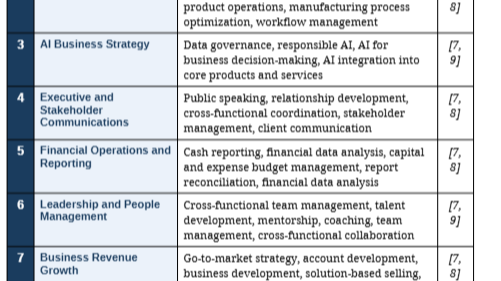
The table below documents the eight skill categories LinkedIn named in its official 2026 Skills on the Rise report for the United States, along with the individual skills that fall under each category. The report was published February 24, 2026, and was based on year-over-year growth in skill acquisition and hiring success from December 2024 through November 2025.⁷ Each row includes the source number that matches the full citation at the end of this article.

What the GMAC Survey Adds: The MBA Skills Employers Prize Most
The table above reflects what LinkedIn’s algorithm is measuring. The GMAC 2025 Corporate Recruiters Survey tells us what 1,108 corporate recruiters and hiring managers at Fortune 500 companies in 46 countries say they value most when they evaluate MBA and business school graduates.¹⁰
For the second consecutive year, the GMAC survey found that problem-solving and strategic thinking are the top two skills employers consider when hiring recent graduate business school candidates.¹¹ Communication, adaptability, and initiative round out the current top five. And knowledge of AI tools has risen measurably in importance since 2024, with 31% of recruiters now citing AI skills as a hiring priority, up from 26% in 2024.¹²
By 2030, GMAC projects AI literacy will become the single most in-demand skill, overtaking strategic thinking at the top of the list.¹³ But right now, in 2026, strategic thinking and problem-solving are still what employers say they want most from MBA hires. These skills are the MBA’s natural territory. They’re also among the most important things to prove on your profile, not just claim.
Christine Murray, associate dean at Georgetown’s McDonough School of Business, stated in the GMAC release that business school graduates should feel empowered to underscore how they are skilled in strategic thinking, problem-solving, and communications alongside technological savvy.¹⁴
Where These Skills Lead: The High-Paying MBA Roles Behind the Demand
These skill clusters don’t exist in a vacuum. They map directly to the highest-paying and highest-demand roles for MBA graduates in 2026. Knowing this helps you choose which three to five skills to prioritize on your own profile.
MIT Sloan’s 2025-2026 MBA Employment Report documented median base salaries of $190,000 in consulting, $180,000 in manufacturing, and $175,000 in finance among its graduating class, with 91% of job-seeking graduates receiving an offer within three months of graduation.¹⁵ The U.S. Bureau of Labor Statistics reported that computer and information systems managers, a common destination for MBAs with AI and analytics skills, earned a median salary of $171,200 in 2024.¹⁶
According to Research.com‘s 2026 MBA salary analysis, MBAs with specializations in finance, business analytics, and technology management consistently see higher earning potential than general business graduates.¹⁷ The University of North Carolina’s 2026 MBA Salary Guide reported that Amazon pays MBA hires in Senior Program Manager roles around $129,412 annually, while Google offers MBA hires in Operations Manager roles an average starting salary of $125,218.¹⁸
The skills driving these salaries match the LinkedIn table exactly. Finance and investment banking demand financial data analysis and risk compliance skills. Consulting firms prize strategic thinking, stakeholder communication, and go-to-market expertise. Technology and product management roles require AI literacy, operational efficiency, and data analytics. Supply chain and operations roles call for process optimization, logistics management, and project management.¹⁹
Remodeling Your Profile: Making These Skills Findable
Understanding which skills matter is only half the work. Embedding them strategically across your profile is what actually drives recruiter visibility. Think of it as renovating a building room by room.
The About Section: Your Load-Bearing Wall
LinkedIn’s algorithm indexes the About section heavily. Structured keyword placement here directly improves your appearance in recruiter searches.²⁰ A high-performing About section follows a simple structure. Open with a compelling first sentence that signals your specialty. Establish credibility through quantified achievements. Name your key skill clusters explicitly. Close with a clear invitation to connect.²¹
▶ True Story: The Invisible Healthcare MBA
Maria had twelve years of hospital administration experience and an MBA, steadily improving patient outcomes through operational redesign. Her LinkedIn About section read: ‘Experienced healthcare professional with strong leadership skills and a passion for patient care.’ Recruiter searches for ‘healthcare operations,’ ‘process optimization,’ or ‘stakeholder management’ never surfaced her. She remodeled her About section to explicitly name AI-assisted workflow tools, cross-functional team coordination, budget management, and regulatory compliance. Three recruiter inquiries arrived within ten days, including one from a major health system seeking a VP of Operations.
The Skills Section: Your Interior Rooms
LinkedIn allows up to 100 skills, and this section is directly searchable in LinkedIn Recruiter.²² The platform’s Skills Graph uses your listed skills as clustering signals to group your profile with similar professionals in recruiter search results. Verified skills boost your chances of getting hired by 30%.²³ List both hard skills such as Power BI, Tableau, SQL, and specific AI tools, alongside soft skills such as Cross-Functional Collaboration, Stakeholder Management, and Strategic Thinking. Pin your top three target skills. Those carry the most weight.
The Experience Section: Your Proof of Construction
Recruiters spend approximately seven seconds scanning a profile. They want evidence of results, not job descriptions.²⁴ Use the Problem, Action, Result framework for every experience entry. Instead of ‘Responsible for managing cross-functional teams,’ write: ‘Led 14-person cross-functional team across finance and operations to consolidate reporting workflows, reducing the close cycle from 18 days to 9 days and saving $340K annually.’ This simultaneously embeds skill keywords and demonstrates impact. That combination is what LinkedIn’s algorithm indexes and what recruiters act on.
▶ True Story: The Supply Chain Leader Who Rebuilt His Profile Like a Skyscraper
David, a 15-year supply chain executive with an MBA, had applied to senior director roles and heard nothing back. His profile listed generic duties beneath each role. He rebuilt his Experience section with outcome-driven entries, each bullet naming skills directly from LinkedIn’s 2026 growth clusters: process optimization, go-to-market strategy, risk compliance management, stakeholder management. He added AI Literacy to his Skills list after completing a LinkedIn Learning AI course and noted specific tools used in his About section. Within six weeks, his profile views increased fourfold. Two Fortune 500 supply chain recruiters called him from keyword searches he never applied to.
The Headline: Your Most Powerful Search Signal
The headline is the single most important field for LinkedIn search visibility. It is indexed at five times the weight of other profile fields.²⁵ A generic job title limits your visibility. A value-driven headline that includes one or two anchor skill keywords increases both your search impressions and your connection acceptance rate significantly.
The Featured and Licenses Sections: The Finishing Touches
The Featured section is prime real estate. Pin a project outcome, a published article, a speaking engagement, or a certification badge. The Licenses and Certifications section lets you display earned credentials with visual badges, and skills-based hiring has made these trust signals increasingly influential for recruiters scanning at speed.²⁶
The Credential Advantage: Certified MBA, MBA+, MBAe and the 21 Specialization Badges
The MBA Standards Board’s Certified MBA™ designation, carried by both the MBA+™ and MBAe™ certifications, validates comprehensive proficiency in MBA core business courses at a level equivalent to a graduate MBA degree.²⁷ These credentials signal exactly the broad business management competency that GMAC confirms employers want. That means versatility in strategic thinking, problem-solving, and communications alongside technological savvy.
While the Certified MBA™, MBA+™, and MBAe™ designations carry that broad foundation, it is wise to obtain one or two of the 21 MBA Standards Board MBA Specialization Badges that carry specific industry depth. Each badge is an electronic LinkedIn credential, displayable in your Licenses and Certifications section, that illustrates to employers the completion of a focused area of specialization.²⁸
The 21 specialization areas offered by the MBA Standards Board are Accounting, Artificial Intelligence, Business Analytics, Business Consultancy, Cybersecurity, E-Commerce, Entrepreneurship, Finance, Fintech, Healthcare Management, Human Resources, Industrial Production Management, Information Technology, International Business, Management Information Systems, Market Research Analyst, Marketing, Operations Management, Project Management, Real Estate, Supply Chain Management, and Sustainability.²⁹
Look at that list and then look back at the eight LinkedIn skill clusters in the table above. They align almost perfectly. An MBA who holds the Certified MBA™ designation and adds an Artificial Intelligence badge, a Fintech badge, or a Business Analytics badge to their Licenses and Certifications section is placing a searchable beacon on their profile, one that fires when a recruiter searches those exact terms.
▶ True Story: The FinTech Badge That Opened the C-Suite Door
One MBA Standards Board member, a financial services professional with over two decades in banking, had applied repeatedly to Chief Risk Officer positions unsuccessfully. After earning his Certified MBA™ and adding the MBA Standards Board’s FinTech and Cybersecurity specialization badges to his LinkedIn Licenses and Certifications section, he reframed his About section around risk compliance management, AI-assisted financial analysis, and cross-functional leadership. He used the exact keyword language LinkedIn recruiters search. Within weeks he secured a newly created Chief Risk Officer role at a compensation level 45% higher than his previous position. He cited his refreshed credentials and remodeled profile as the decisive factor in surfacing him in the search.
Your Six-Step Profile Construction Plan
LinkedIn’s Skills Graph clusters your profile with similar professionals based on your pinned top skills. Fifty mediocre skills make you invisible in every cluster. But three to five high-demand skills embedded consistently across your Headline, About, Experience, and Skills sections make you highly visible in precisely the searches that matter.³¹
- Pull three to five job descriptions from roles you are targeting. Highlight the skill keywords that repeat across all of them. These become your anchor terms.
- Rewrite your Headline to include your top one or two anchor skills alongside your title. The headline is indexed at five times the weight of other profile fields.²⁵
- Open your About section with a hook that names your specialty, then build your anchor skills naturally across two to three paragraphs. Close with a clear call to action such as ‘Open to senior finance leadership roles, connect with me here.’
- Revise every Experience entry using the Problem, Action, Result framework. Name specific tools, methodologies, and quantified outcomes that embed your anchor skill terms.
- Pin your top three target skills in the Skills section. Add your MBA Standards Board Certified MBA™ designation and one or two specialization badges in the Licenses and Certifications section. Seek endorsements from colleagues who can verify those skills.
- Post or share content relevant to your skill cluster at least once a week. LinkedIn’s algorithm rewards active profiles with higher placement in recruiter search results.³²
The Blueprint Is in Your Hands
LinkedIn is a search engine, not a scrapbook. Every word in your profile is either helping recruiters find you or helping them skip you. The eight skill clusters in the table above, all documented from verified 2025 and 2026 sources, are what the algorithm is searching for right now.
Your Certified MBA™ with MBA+™ or MBAe™ designation from the MBA Standards Board signals broad business leadership competency. Layering one or two of the 21 specialization badges on top, in an area aligned to your target industry and to the skill clusters above, creates a searchable, credentialed profile that stands apart from the noise.
The house is yours to build. Pick up the tools.
BOARD SERVICE OPPORTUNITY: The MBA Leaders Forum Professional Association was built for exactly this moment. As a Founding Advisory Board Member you receive MBA+™ and Certified MBA™ digital credentials embedded with the skill metadata that AI hiring systems are designed to find. You get a permanent Founding Board title, C-suite peer network access, and a verified professional footprint that works for you every single day. The commitment is one hour a month. Founding cohort seats are limited and closing soon. If you hold an MBA or equivalent advanced degree and want to be on the right side of this shift before it becomes obvious that you needed to be, reach out to me to apply or learn more. Message me directly here on LinkedIn at linkedin.com/in/cherylnunn or email me at [email protected]
The window to be a founder of something is always short; by definition, our deadline is May 4th.
Sources
Superscript footnote numbers in the article above match the source numbers below. Harvard citation style.
1. BestJobSearchApps (2025) ‘The Complete LinkedIn Job Search Guide for 2025’, BestJobSearchApps.com. Available at: https://bestjobsearchapps.com/articles/en/the-complete-linkedin-job-search-guide-for-2025 (Accessed: 21 April 2026). [Cited in: The Search Reality]
2. CareerBldr (2025) ‘The Complete LinkedIn Profile Optimization Guide for 2026’, CareerBldr Blog, November 2025. Available at: https://careerbldr.com/blog/linkedin-profile-optimization-guide/ (Accessed: 21 April 2026). [Cited in: The Search Reality; Step 2]
3. Seaman, A. (2025) ‘Fast-growing skills employers want to see on your resume: LinkedIn report’, CNBC, 19 March 2025. Available at: https://www.cnbc.com/2025/03/19/fast-growing-skills-employers-want-to-see-on-your-resume-linkedin-report.html (Accessed: 21 April 2026). [Cited in: The Search Reality]
4. CyberWarrior76 (2026) ‘The Comprehensive LinkedIn Optimization and Engagement Guide for 2026’, Substack, 8 March 2026. Available at: https://cyberwarrior76.substack.com/p/the-comprehensive-linkedin-optimization (Accessed: 21 April 2026). [Cited in: The Search Reality; Skills Section]
5. FactoryForMen (2026) ‘LinkedIn Profile Optimization Recruiter Attraction Guide’, FactoryForMen.com, February 2026. Available at: https://factoryformen.com/en/how-to-attract-recruiters-on-linkedin/ (Accessed: 21 April 2026). [Cited in: The Search Reality]
6. LiSeller (2025) ‘How Keywords Impact LinkedIn Profile Visibility’, LiSeller Blog. Available at: https://www.liseller.com/linkedin-growth-blog/how-keywords-impact-linkedin-profile-visibility (Accessed: 21 April 2026). [Cited in: The Search Reality, 27x statistic]
7. LinkedIn Corporate Communications (2026) ‘Skills on the Rise: The Fastest-Growing Skills in 2026’, LinkedIn Newsroom, 24 February 2026. Available at: https://news.linkedin.com/2026/Skills-on-the-rise-2026 (Accessed: 21 April 2026). [Primary source for entire skill table; cited throughout]
8. Seaman, A. (2026) ‘These are the fastest-growing skills in the U.S., according to LinkedIn’, CNBC Make It, 24 February 2026. Available at: https://www.cnbc.com/2026/02/24/the-fastest-growing-skills-in-the-us-according-to-linkedin-theyre-career-currency.html (Accessed: 21 April 2026). [Cited in: Skill table, all eight categories and individual skills]
9. ETS Insights (2026) ‘LinkedIn Skills on the Rise 2026: The Skills that Surprised Our Leaders Across the Globe’, ETS.org, 26 February 2026. Available at: https://www.ets.org/insights-and-perspectives/linkedin-skills-on-the-rise-2026-the-skills-that-surprised.html (Accessed: 21 April 2026). [Cited in: Skill table, AI Business Strategy, Leadership and People Management]
10. Graduate Management Admission Council (2025) ‘Corporate Recruiters Survey, 2025 Report’, GMAC, 1 July 2025. Available at: https://gmac.com/market-intelligence-and-research/market-research/corporate-recruiters-survey (Accessed: 21 April 2026). [Cited in: GMAC Survey section]
11. BestColleges (2025) ‘Employers Remain Confident in Graduate Business Education’, BestColleges.com, 9 July 2025. Available at: https://www.bestcolleges.com/news/2025-gmac-corporate-recuriters-survey-ai-human-skills/ (Accessed: 21 April 2026). [Cited in: GMAC Survey section, problem-solving and strategic thinking ranked top two]
12. BusinessBecause (2025) ‘Employer Confidence In MBA Talent Remains Strong Amid AI And Evolving Work Models’, BusinessBecause.com, July 2025. Available at: https://www.businessbecause.com/news/in-the-news/9823/employer-confidence-in-mba-talent-remains-strong (Accessed: 21 April 2026). [Cited in: GMAC Survey section, 31% AI priority statistic]
13. Candidate.Coach (2025) ‘Understanding GMAC’s Corporate Recruiter Report for MBA Applicants’, Candidate.Coach, 21 August 2025. Available at: https://www.candidate.coach/post/understanding-gmac-s-corporate-recruiter-report (Accessed: 21 April 2026). [Cited in: GMAC Survey section, 2030 projection]
14. Graduate Management Admission Council (2025) ‘New Survey Finds Employers Keen on Hiring Business School Graduates as AI Integration Accelerates’, PR Newswire, 1 July 2025. Available at: https://www.prnewswire.com/news-releases/new-survey-finds-employers-keen-on-hiring-business-school-graduates-as-ai-integration-accelerates-302492429.html (Accessed: 21 April 2026). [Cited in: GMAC Survey section, Christine Murray quote]
15. MIT Sloan School of Management (2025) ‘2025-2026 MBA Employment Report’, MIT Sloan. Available at: https://mitsloan.mit.edu/sites/default/files/2025-12/2025-2026-MBA-Employment-Report.pdf (Accessed: 21 April 2026). [Cited in: High-Paying Roles section, median salary data]
16. UNC Kenan-Flagler Business School (2026) ‘2026 MBA Salary Guide: Top Careers and Earning Potential’, UNC Online MBA. Available at: https://onlinemba.unc.edu/news/mba-salary/ (Accessed: 21 April 2026). [Cited in: High-Paying Roles section, BLS computer/information systems manager salary]
17. Research.com (2026) ‘2026 Highest Paying MBA Jobs and Careers’, Research.com, February 2026. Available at: https://research.com/careers/highest-paying-mba-jobs-and-careers (Accessed: 21 April 2026). [Cited in: High-Paying Roles section, finance/analytics/tech earning premium]
18. MBAGradSchools (2026) ‘Best MBA Salaries in 2026: Career Growth and Top Schools’, MBAGradSchools.com, 18 March 2026. Available at: https://mbagradschools.com/mba-jobs/mba-salaries (Accessed: 21 April 2026). [Cited in: High-Paying Roles section, Amazon and Google MBA salary figures]
19. Research.com (2026) ‘2026 MBA Degree Salaries: Guide to Highest Paying Concentrations’, Research.com. Available at: https://research.com/degrees/mba-degree-salaries-guide-to-highest-paying-concentrations (Accessed: 21 April 2026). [Cited in: High-Paying Roles section, skill-to-role mapping]
20. GrowLeads (2025) ‘LinkedIn Profile Checklist: The Complete 2025 Guide’, GrowLeads Blog, November 2025. Available at: https://growleads.io/blog/linkedin-profile-checklist/ (Accessed: 21 April 2026). [Cited in: About Section]
21. CareerBldr (2025) ‘How to Write a Compelling LinkedIn About Section’, CareerBldr Blog, December 2025. Available at: https://careerbldr.com/blog/linkedin-about-section-guide/ (Accessed: 21 April 2026). [Cited in: About Section, Hook/Proof/CTA structure]
22. CyberWarrior76 (2026) op. cit. [Cited in: Skills Section, 100-skill limit and searchability]
23. Skrapp.io (2026) ‘LinkedIn Profile Optimization Tips for 2026’, Skrapp.io Blog, February 2026. Available at: https://skrapp.io/blog/linkedin-profile-optimization/ (Accessed: 21 April 2026). [Cited in: Skills Section, 30% hire-rate boost from verified skills]
24. CyberWarrior76 (2026) op. cit. [Cited in: Experience Section, 7-second recruiter scan]
25. CareerBldr (2025) ‘The Complete LinkedIn Profile Optimization Guide for 2026’, op. cit. [Cited in: Headline section and Step 2, 5x indexing weight]
26. Resume.io (2026) ’25 Best Skills to Add to LinkedIn (2026 Examples)’, Resume.io. Available at: https://resume.io/blog/skills-to-add-to-linkedin (Accessed: 21 April 2026). [Cited in: Featured and Licenses section]
27. MBA Standards Board (2025) ‘About Us’, MBA Standards Board / ApplyMBA.org. Available at: https://applymba.org/about-us/ (Accessed: 21 April 2026). [Cited in: Credential Advantage section, Certified MBA designation]
28. MBA Standards Board (2025) ‘MBA Specializations’, MBA Standards Board / ApplyMBA.org. Available at: https://applymba.org/mba-specializations-2/ (Accessed: 21 April 2026). [Cited in: Credential Advantage section, specialization badges as LinkedIn credentials]
29. MBA Standards Board (2025) ‘MBA Curriculum’, MBA Standards Board / ApplyMBA.org. Available at: https://applymba.org/mba_curriculum/ (Accessed: 21 April 2026). [Cited in: Credential Advantage section, full list of 21 specializations]
30. MBA Standards Board (2025) ‘Eligibility’, MBA Standards Board / ApplyMBA.org. Available at: https://applymba.org/eligibility/ (Accessed: 21 April 2026). [Cited in: FinTech Badge true story]
31. GrowLeads (2025) ‘LinkedIn Profile Optimization for Beginners (2025 Edition)’, GrowLeads Blog, December 2025. Available at: https://growleads.io/blog/linkedin-profile-optimization-beginners/ (Accessed: 21 April 2026). [Cited in: Six-Step Plan, Skills Graph clustering]
32. RKY Careers (2026) ‘Turning Your LinkedIn into a Job Magnet in 2026’, RKYCareers.com, January 2026. Available at: https://rkycareers.com/blog/turning-your-linkedin-into-a-job-magnet-in-2026/ (Accessed: 21 April 2026). [Cited in: Step 6, posting frequency and algorithm boost]
© 2026 MBA Standards Board • ApplyMBA.org • For professional development and informational purposes only.