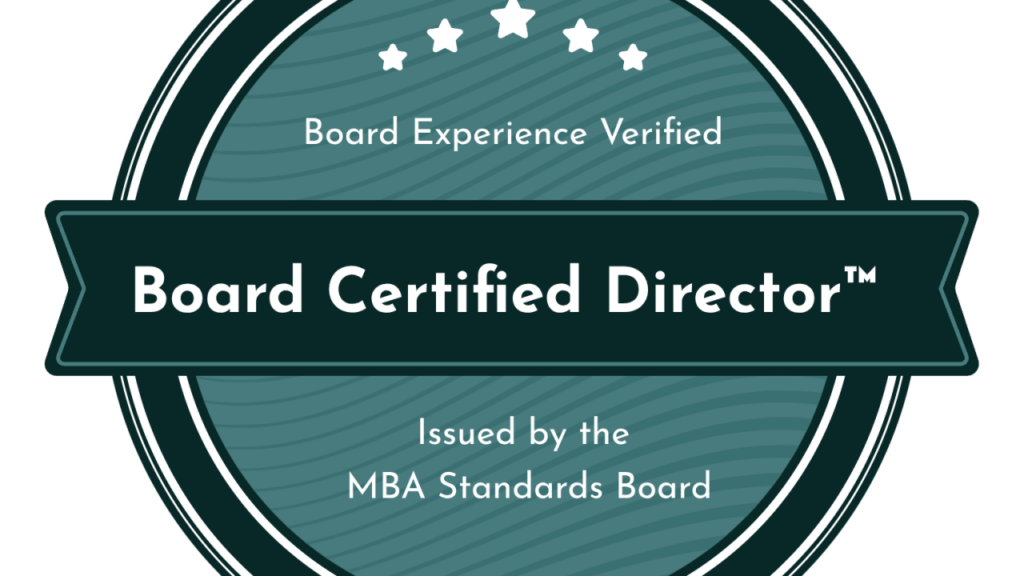
Quick Summary – The Board Certified Director™ is a verified digital badge credential issued by the MBA Standards Board for professionals who have completed six or more months of active board service. It is registered in the Credential Engine Registry under the CTDL open data standard and embeds ten governance skill terms into LinkedIn’s recruiter search database. Median compensation for Fortune 500 board directors reached $335,000 in 2025. The credential is designed for both board-seeking professionals and those pursuing C-suite advancement. Two pathways exist: pro bono board service as the entry track, and compensated corporate board service as the advanced track. The credential is independently verifiable by anyone who clicks the badge link.
Board service is one of the most powerful career accelerators available to a senior professional. It signals strategic credibility, governance fluency, and leadership at the highest level. And yet, in 2026, millions of accomplished professionals who serve on corporate, nonprofit, advisory, and standards boards carry that experience on their LinkedIn profiles in a way that makes it nearly invisible to the recruiters, nominating committees, and search firms looking for exactly what they have.
Others seeking C-Suite positions or to advance their careers in other ways should read this article as it applies to their success and career strategy as well.
That is the problem the MBA Standards Board’s Board Certified Director™ credential was built to solve.
The Board Service Landscape: What the Data Says
Board seats at the highest levels are genuinely rare, genuinely competitive, and genuinely lucrative. But most professionals do not understand the full scope of the market or the pathway that leads to those compensated seats.
Start with the numbers. According to Heidrick and Struggles’ 2026 Board Monitor US report, 383 Fortune 500 board seats were filled in 2025, exactly matching the long-term average.¹ Spencer Stuart’s 2025 US Board Index confirms that S&P 500 boards appointed 374 new independent directors in 2025, an 8% decrease from the prior year and the lowest number since 2016.² With average board tenure sitting at 7.7 years and an average of 2.3 years between appointments at any given company, the pipeline for compensated public company board seats is genuinely tight.³
What are those seats worth? The numbers are significant. Compensation Advisory Partners’ analysis of 2025 proxy disclosures for the 100 largest US public companies found that median board compensation rose 3% year over year to $335,000, with pay structured as 64% equity and 36% cash.⁴ The National Association of Corporate Directors reported that median director pay at the top 200 S&P 500 firms exceeded $323,000 annually.⁵ According to executive compensation firm Veritas, compensation for board members at the largest companies can reach $300,000 to $500,000 a year.⁶
These are part-time roles. The average director dedicates approximately 250 hours per year to board service.⁷ At those compensation levels, the math is compelling for any senior professional with the right credentials and experience to compete.
But here is what the data also reveals. A supply problem is emerging. The EY Center for Board Matters notes that the supply of qualified board candidates far exceeds demand, while simultaneously, boards strongly prefer candidates they personally know and demonstrate significant bias toward those who already hold public board experience.⁸ Heidrick and Struggles found that 74% of Fortune 500 seats filled in 2025 went to professionals with prior public board experience, the second-highest share since tracking began in 2011.⁹

The Career Case Beyond the Boardroom: How Board Credentials Open C-Suite Doors and Career Advancement
Not every senior professional is chasing a Fortune 500 board seat. The math alone tells you why. Fewer than 400 new independent director appointments happen across the entire S&P 500 in a given year. The competition is real, the network requirements are steep, and the timeline from aspiration to appointment can stretch across a decade. But here is what the board credential conversation almost always misses. The skills embedded in the Board Certified Director™ are not just board skills. They are the exact skills that separate a senior manager from a C-suite executive in the eyes of every hiring committee, every promotion panel, and every executive search firm that fills the roles that actually are available at scale.
Corporate governance. Strategic planning. Risk management. Fiduciary oversight. Stakeholder engagement. AI governance. These are not abstract governance concepts that matter only in a boardroom. They are the precise competencies that CEOs, CFOs, COOs, and Chief Risk Officers are expected to demonstrate from their first day in the role. The professional who holds the Board Certified Director™ badge and carries those ten verified skill terms on their LinkedIn profile is telling every recruiter and every internal promotion committee something that most of their peers cannot say. They have practiced governance, not just managed within it. That distinction is significant and it shows up in hiring decisions.
Think about what happens when a company is looking to elevate someone into a Chief Operating Officer or Chief Strategy Officer position. The internal or external candidate pool typically includes talented operators who have driven results within their function.
What separates the ones who get the role from the ones who stay behind is almost always the same thing. Evidence of thinking beyond that function.
Evidence of enterprise-level accountability. Evidence of the kind of strategic oversight and risk awareness that a board would expect from the person running the business. The Board Certified Director™ credential documents exactly that mindset in a form that is searchable, verifiable, and immediately legible to the hiring authority making the decision.
For professionals seeking C-suite advancement at their current company, the credential carries a different but equally powerful message. It signals readiness before the role is offered rather than after. Most internal candidates wait to be seen as executive material. The professional who holds a verified governance credential and displays it prominently on their LinkedIn profile is actively communicating to their own leadership team that they are already thinking and operating at a level above their current title.
That proactive signaling changes how leadership perceives them in strategic meetings, in conversations about succession planning, and in the quiet deliberations that happen before a promotion is ever formally discussed.
For professionals seeking to move to a better company or a higher-level role externally, the credential does something even more concrete. LinkedIn Recruiter filters used by executive search firms allow recruiters to screen for specific verified skills. A candidate who has Corporate Governance, Strategic Planning, and Stakeholder Engagement listed as verified skills surfaces in searches that candidates without those terms simply do not appear in, regardless of how impressive their actual background is. The algorithm does not know you are ready for a C-suite role unless your profile speaks the language that C-suite searches use. The Board Certified Director™ teaches your profile that language in the most direct and verifiable way available.
There is also a perception effect that operates independently of any algorithm. When a hiring manager, a CEO interviewing a candidate for a CFO role, or a board nominating committee evaluating an internal executive sees the Board Certified Director™ badge on a profile, they are receiving a signal that this person has gone beyond the expectations of their current role. They served. They were accountable to a governance structure outside of their day job. They built skills in an environment where the stakes were organizational rather than departmental. That kind of voluntary governance engagement tells a story about character, judgment, and leadership aspiration that a resume alone cannot tell.
The bottom line is this. The Board Certified Director™ was built with the boardroom in mind, but its value extends to anyone whose career ambition puts them in the orbit of executive leadership. Whether you are one promotion away from the C-suite at your current company, actively searching for a senior executive role externally, or positioning yourself to be taken seriously in conversations about organizational leadership, verified governance credentials are no longer a niche signal for a narrow audience. They are a fundamental component of the executive identity that the 2026 job market rewards. Build the credential now. The boardroom may or may not come. The career advancement almost certainly will.
Two Tracks, One Destination
Track One is pro bono board service. It is available to almost any senior professional willing to seek it, and it is the single most documented pathway to eventually landing a compensated director role.
Nonprofit boards, professional association boards, advisory boards, standards boards, community boards, and educational institution boards all represent legitimate governance experience that nominating committees recognize and value. The NACD’s own governance research confirms that boards actively look for directors who have demonstrated governance accountability in any organizational context, and that nonprofit board service builds the financial oversight, stakeholder management, and strategic planning skills that translate directly to corporate governance.¹⁰
BoardSource, the leading authority on nonprofit governance, notes that establishing an organization’s purpose and setting its strategic direction is the most essential board leadership role, and that these responsibilities are identical in substance whether the board is a global corporation or a community foundation.¹¹
The skills transfer completely. The credential, historically, did not.
Track Two is compensated board service. It is available to professionals who can demonstrate prior governance experience, specific expertise in areas boards are actively seeking, a verifiable record of strategic contribution, and the kind of professional network that gets a name onto a shortlist before the search firm is even engaged. Spencer Stuart’s board recruiting analysis confirms that the most effective boards are seeking directors who bring strategic impact, a governance mindset, and the ability to manage complexity with clarity and confidence.¹²
The pathway from Track One to Track Two requires three things. Time in a governance role. A documented record of that service. And a way to make that record visible and verifiable to the search firms, nominating committee chairs, and institutional investors who make the decisions.
Until now, there has been no standardized credential to do that.
Why a Verified Board Service Credential Is Needed Right Now
Corporate board recruiting in 2026 is being shaped by three converging forces. Heightened regulatory scrutiny around board composition disclosures, growing demand for directors with AI and cybersecurity fluency, and an increasingly global candidate pool enabled by hybrid governance models.¹³
The SEC’s expanded board disclosure requirements, effective for fiscal years beginning in 2025, mean that nominating committees now face both strategic and compliance pressures to broaden their search criteria. Institutional investors are paying closer attention to whether boards have the technical expertise to oversee AI deployment, data privacy, and emerging technology risks.¹⁴
The Corporate Governance Institute identifies five skills that define governance success in 2025 and 2026. Digital literacy, ESG expertise, crisis management, stakeholder engagement, and strategic thinking.¹⁵ Harvard Law School’s Forum on Corporate Governance adds that today’s most effective boards are shifting from passive oversight to active, data-driven governance, where disciplined human judgment works alongside AI to improve decision-making and risk management.¹⁶
And yet, despite all of this documented demand for verifiable governance competency, there is no widely adopted credential that a board member can earn, display on LinkedIn, and have independently verified by anyone who clicks it.
A published article listing board roles is not verifiable. A job title entry saying Board Advisor is not verifiable. A LinkedIn recommendation from a fellow board member is not verifiable. What a recruiter, a nominating committee chair, or an institutional investor actually needs is a credential backed by a credentialing organization, registered in a recognized registry, carrying embedded metadata about the service period and competencies demonstrated, and linked to a verification page that confirms authenticity with a single click.
That is exactly what the Board Certified Director™ credential provides.
The Board Certified Director™ Credential
The Board Certified Director™ is a verified digital badge awarded to professionals who have completed a minimum of six months of active board service in good standing on a qualifying corporate, nonprofit, advisory, professional association, or standards board.
It is registered in the Credential Engine Registry under the Credential Transparency Description Language (CTDL) open data standard, making it independently verifiable by employers, recruiters, and institutions worldwide.¹⁷ Every badge carries a unique credential ID that links directly to the holder’s verification page, preventing misuse, fraud, or duplication.¹⁸
The credential is designed for board members everywhere, including those serving on the MBA Standards Board or the MBA Leaders Forum. Any qualifying board professional who meets the service and standards requirements is eligible to apply.
The ten skills embedded in the Board Certified Director™ badge metadata are the exact terms that corporate board recruiters, executive search firms, and nominating committee chairs search for on LinkedIn when sourcing director candidates. In order of recruiter search frequency, they are Corporate Governance, Board of Directors Experience, Board Oversight, Fiduciary Oversight, Executive Leadership, Stakeholder Engagement, AI Governance, ESG Strategy, Corporate Strategy, and CEO Succession Planning. These are not invented categories. They are the skill terms confirmed by multiple board recruiting authorities as the most active search terms used to identify director candidates in 2026.¹⁹
LinkedIn’s own data confirms that verified credentials boost a professional’s chances of getting hired by 30%, and that verified members see 60% more profile views on average.²⁰
For a board member trying to move from pro bono service to compensated directorship, those are not marginal improvements. They are the difference between being found and being invisible.
How This Credential Changes Your Career Trajectory
Consider what happens when a nominating governance committee chair opens LinkedIn Recruiter and searches for candidates with Corporate Governance, AI Governance, and Stakeholder Engagement skills listed and verified. Two profiles come up. One is an accomplished executive whose board service is listed as a past job title with no verification, no credential, and no embedded skills metadata. The other holds the Board Certified Director™ badge, which links to a verification page confirming six months of active board service, lists all ten governance skill terms in machine-readable format, and carries the authority of a credential registered in the Credential Engine Registry.
The algorithm surfaces both. Humans make a choice in seven seconds. The credential wins every time.
This is not theoretical. Spencer Stuart notes that board placements increasingly happen before the search firm is engaged, through the personal networks of existing board members and governance chairs.²¹ The Board Certified Director™ is designed to expand that personal network effect by making governance experience visible and credible to decision-makers who do not yet know you personally but are actively searching for what you have already done.
The Strategy: Start Now, Document Everything, Display It Properly
If you currently serve on any qualifying board and have done so for six months or longer, you are already eligible to apply for the Board Certified Director™ credential. Start there. Ask your organization to provide that credential. The MBA Standards Board and the MBA Leaders Forum Professional Association both provide it to their qualified board members in good standing.
If you are not yet serving on a board, the pro bono path is your first step. Identify a nonprofit, professional association, advisory board, or standards organization whose mission aligns with your expertise. Offer your strategic skills. Serve with intention. Document your contributions. Six months of genuine engagement builds the foundation that nominating committees and search firms need to see.
Once you hold the credential, deploy it correctly. Add it to your LinkedIn Licenses and Certifications section. Embed the verified link. Add the ten governance skill terms to your LinkedIn Skills section. Rewrite your Headline to include Corporate Governance or Board Leadership alongside your title. Update your About section to name your board service experience explicitly, using the governance language that recruiting algorithms and nominating chairs are trained to recognize.
And when your service extends, renew. The continuing education requirement built into the Board Certified Director™ ensures that every credential holder remains current, engaged, and genuinely committed to governance excellence rather than collecting a credential and going dark.
The compensated board seat or an offer to join the C-Suite does not arrive by accident.
Career advancement arrives because the right person, with the right experience, made their experience visible in the right way at the right moment. The Board Certified Director™ credential is built to create that moment for those who prepared themselves with decisive advance preparation.
Frequently Asked Questions
What is the Board Certified Director™ credential? The Board Certified Director™ is a verified digital badge issued by the MBA Standards Board to professionals who have completed a minimum of six months of active board service on a qualifying corporate, nonprofit, advisory, professional association, or standards board. It is registered in the Credential Engine Registry and embeds ten governance skill terms into LinkedIn’s searchable skills database.
Who qualifies for the Board Certified Director™ credential? Any professional who has served actively on a qualifying board for six or more months in good standing qualifies to apply. This includes corporate directors, nonprofit trustees, advisory board members, standards board members, and professional association board members.
How much do Fortune 500 board directors earn? According to Compensation Advisory Partners’ 2025 analysis, median board compensation at the 100 largest US public companies reached $335,000, structured as 64% equity and 36% cash. Top compensation at the largest companies can reach $300,000 to $500,000 annually for approximately 250 hours of work per year.
What skills does the Board Certified Director™ credential verify? The credential embeds ten governance skill terms as machine-readable LinkedIn metadata: Corporate Governance, Board of Directors Experience, Board Oversight, Fiduciary Oversight, Executive Leadership, Stakeholder Engagement, AI Governance, ESG Strategy, Corporate Strategy, and CEO Succession Planning.
How does board service help C-suite career advancement? Board service demonstrates enterprise-level accountability, strategic oversight, and governance fluency that hiring committees use to distinguish C-suite candidates from senior managers. The verified skill terms embedded in the credential surface the holder in LinkedIn Recruiter searches used by executive search firms filling COO, CFO, and Chief Strategy Officer roles.
How do I apply for the Board Certified Director™ credential? Contact the MBA Standards Board at [email protected] or visit ApplyMBA.org. Qualifying board members of the MBA Leaders Forum Professional Association receive the credential as part of their board membership benefits.
What is the difference between pro bono and compensated board service? Pro bono board service includes nonprofit boards, advisory boards, standards boards, and professional association boards. It is the documented pathway to compensated corporate board service. Compensated board service at public companies pays a median of $335,000 annually but requires to be demonstrated prior governance experience, which pro bono service provides.
Is the Board Certified Director™ recognized internationally? Yes. The credential is registered in the Credential Engine Registry under the internationally recognized CTDL open data standard, making it independently verifiable by employers, recruiters, and institutions worldwide.
About the Author
Cheryl Nunn, MBAe™, is the Founder and CEO of the MBA Standards Board, the independent professional standards organization that defines, verifies, and registers MBA-level business credentials in the Credential Engine Registry under the CTDL open data standard. She holds the MBAe™ designation and specializes in AI Strategy for Executives, the Future of Work, and MBA credential innovation. The MBA Standards Board operates under International Business Education and Accreditation Council LLC and issues the CMBA™, MBAe™, Certified MBA™, and Board Certified Director™ credentials. Contact: [email protected]. Website: ApplyMBA.org.
Sources
Superscript footnote numbers in the article above match the source numbers below. Harvard citation style.
¹ Heidrick and Struggles (2026) ‘2026 Board Monitor US: The Day-One Director’, Heidrick and Struggles Insights. Available at: https://www.heidrick.com/en/insights/boards-governance/board-monitor-us-2026-demographic-report (Accessed: 23 April 2026). [Cited in: Board Service Landscape, 383 Fortune 500 seats filled in 2025]
² Harvard Law School Forum on Corporate Governance (2025) ‘2025 US Board Index’, Harvard Law School Forum, 3 November 2025. Available at: https://corpgov.law.harvard.edu/2025/11/03/2025-u-s-board-index/ (Accessed: 23 April 2026). [Cited in: Board Service Landscape, 374 new S&P 500 directors in 2025]
³ Heidrick and Struggles (2026) op. cit. [Cited in: Board Service Landscape, 7.7-year average tenure and 2.3 years between appointments]
⁴ Compensation Advisory Partners (2025) ‘Director Compensation: Pay Increases Again, Led by Larger Equity Grants’, CAP Thinking, 10 September 2025. Available at: https://www.capartners.com/cap-thinking/director-compensation-pay-increases-again-led-by-larger-equity-grants/ (Accessed: 23 April 2026). [Cited in: Board Service Landscape, $335,000 median compensation]
⁵ National Association of Corporate Directors (2026) ‘Public Company Director Pay Rises 3% as Board Expectations Expand’, NACD Newsroom, 29 January 2026. Available at: https://www.nacdonline.org/about/newsroom/press-release/press-release/public-company-director-pay-rises-expectations-expand (Accessed: 23 April 2026). [Cited in: Board Service Landscape, median director pay data]
⁶ The Corporate Governance Institute (2025) ‘How Much Do Board Members Get Paid?’, CGI Insights, November 2025. Available at: https://www.thecorporategovernanceinstitute.com/insights/guides/how-much-do-board-members-get-paid/ (Accessed: 23 April 2026). [Cited in: Board Service Landscape, $300,000 to $500,000 range]
⁷ Yahoo Finance / Compensation Advisory Partners (2023) ‘Here’s How Much Big Companies Are Paying Their Board Members’, Yahoo Finance. Available at: https://finance.yahoo.com/news/much-big-companies-paying-board-114500446.html (Accessed: 23 April 2026). [Cited in: Board Service Landscape, 250 hours per year average]
⁸ EY Center for Board Matters (2025) ‘The Board Service Landscape’, EY. Available at: https://cs.ey.com/2025/03/11922/board-landscape.html (Accessed: 23 April 2026). [Cited in: Two Tracks section, supply/demand imbalance and preference for known candidates]
⁹ Heidrick and Struggles (2026) op. cit. [Cited in: Two Tracks section, 74% of seats filled by prior board members]
¹⁰ National Association of Corporate Directors (2025) ‘2025 Inside the Public Company Boardroom’, NACD. Available at: https://www.nacdonline.org/all-governance/governance-resources/governance-surveys/surveys-benchmarking/2025-inside-the-public-company-boardroom/ (Accessed: 23 April 2026). [Cited in: Two Tracks section, governance skills transferability]
¹¹ BoardSource (2026) ‘Serve on a Nonprofit Board’, BoardSource.org. Available at: https://boardsource.org/fundamental-topics-of-nonprofit-board-service/composition-recruitment/board-service/ (Accessed: 23 April 2026). [Cited in: Two Tracks section, strategic direction as core board role]
¹² DS Career Management / Spencer Stuart (2025) ‘5 Key Board Recruitment Trends from Spencer Stuart’, DSCareerManagement.com, 13 November 2025. Available at: https://www.dscareermanagement.com/post/5-key-board-recruitment-trends-from-spencer-stuart (Accessed: 23 April 2026). [Cited in: Two Tracks section, strategic impact and governance mindset]
¹³ OnBoard Meetings (2026) ‘Corporate Board Recruiting: 5 Emerging Trends in 2026’, OnBoard Blog, 11 February 2026. Available at: https://www.onboardmeetings.com/blog/corporate-board-recruiting/ (Accessed: 23 April 2026). [Cited in: Why a Credential Is Needed, three converging forces]
¹⁴ OnBoard Meetings (2026) op. cit. [Cited in: Why a Credential Is Needed, SEC disclosure requirements and AI oversight demand]
¹⁵ The Corporate Governance Institute (2025) ‘Most Important Boardroom Skills 2025’, CGI Thought Leadership, 28 November 2025. Available at: https://www.thecorporategovernanceinstitute.com/insights/thought-leadership/most-important-boardroom-skills-2025/ (Accessed: 23 April 2026). [Cited in: Why a Credential Is Needed, five core governance skills]
¹⁶ Harvard Law School Forum on Corporate Governance (2026) ‘Board Governance in 2026’, Harvard Law School Forum, 11 February 2026. Available at: https://corpgov.law.harvard.edu/2026/02/11/board-governance-in-2026/ (Accessed: 23 April 2026). [Cited in: Why a Credential Is Needed, active data-driven governance shift]
¹⁷ Credential Engine (2025) ‘Building Trust in a Digital World: Scalable Solutions for Verifiable Credential Ecosystems’, Credential Engine, 9 June 2025. Available at: https://credentialengine.org/2025/06/09/building-trust-in-a-digital-world-scalable-solutions-for-verifiable-credential-ecosystems/ (Accessed: 23 April 2026). [Cited in: Board Certified Director section, CTDL open data standard]
¹⁸ Certifier.io (2026) ‘How to Create a LinkedIn Certification Badge in 2026’, Certifier Blog, 13 March 2026. Available at: https://certifier.io/blog/how-to-create-a-linkedin-certification-badge (Accessed: 23 April 2026). [Cited in: Board Certified Director section, unique credential ID and verification]
¹⁹ ProResource (2026) ‘How to Use LinkedIn to Attract Board Roles’, ProResource.com, 26 January 2026. Available at: https://www.proresource.com/how-to-use-linkedin-to-attract-board-roles/ (Accessed: 23 April 2026). [Cited in: Board Certified Director section, governance skill terms for LinkedIn recruiter searches]
²⁰ VerifyEd (2025) ‘LinkedIn Digital Badge: Step-by-Step Setup Guide for 2025’, VerifyEd Blog. Available at: https://www.verifyed.io/blog/linkedin-badge-setup-guide (Accessed: 23 April 2026). [Cited in: Board Certified Director section, 30% hire rate boost and 60% more profile views]