Jim Collins released his most personal book yesterday. After a decade of research studying 34 remarkable lives across every field imaginable, the bestselling author of Good to Great: Why Some Companies Make the Leap…And Others Don’t has turned his legendary research methodology toward something most business books are afraid to touch directly. Not company performance. Not leadership theory. The actual question of what happens to a person when everything they built their identity around stops working.
The book is called What to Make of a Life: Cliffs, Fog, Fire and the Self-Knowledge Imperative. And if you have an MBA, you should read it this week.

Here is why. Collins spent ten years studying matching pairs of remarkable people. Two rock musicians are facing a future without their band. Two public figures rebuilding after scandal. Two suffragists who won everything they fought for and then didn’t know who they were anymore. What Collins found in every single case is that cliffs are unavoidable. He tried to find subjects who had avoided major life disruptions entirely, as methodological control. He could not find any. Not one.
A cliff, in Collins’ framework, is any event that ends life as you knew it so completely that you are forced to ask the fundamental question all over again. What is it to make of a life.
The AI consolidation wave happening right now is a cliff. Not a metaphorical one. A real one, and it is already reshaping which MBA skills matter and which MBAs are becoming invisible.
The Encoding Missing in Most of Your Credentials
One of the most striking ideas Collins surfaces in this new book is what he calls encodings. These are the deep, often unrecognized capabilities and drives that define what a person is naturally built to do. Not what they were trained for. Not what their resume says. What they actually are at the level that shows up under pressure. In his interview with Oprah yesterday she mentioned how she was in a fog when her network talk show ended. How she tried building a new TV network, and how nothing worked for until she returned to her “calling” or as Collins would call it her encoding of doing thought provoking interviews on her Podcast Series.
Here is what is fascinating about this concept in the context of your MBA career. Collins found, repeatedly, that cliffs do not destroy encodings. They expose them.
Alan Page played defensive tackle for the Minnesota Vikings for over a decade. When his football career ended, he had been quietly taking law classes during his playing years, watering a seed that had been planted in childhood watching courtroom dramas. That anticipatory simplex step, as Collins calls it, meant that when the cliff arrived, some of the fog had already cleared before he reached it. Page went on to serve 23 years on the Minnesota Supreme Court and launched the Page Education Foundation.
Collins contrasts him with Carl Eller, his teammate on those same Viking teams, who also had a remarkable second act in community leadership and addiction recovery work. Both men faced the identical cliff at roughly the same age. Both found their encodings on the other side of it. But Page’s pre-clearing of the path, that quiet preparation before the cliff hit, made the fog shorter.
What does your encoding tell you about the work you are actually meant to do? And more practically, can anyone find you for that work right now?
The Hidden Problem Most MBAs Do Not See Coming
Job search strategist J.T. O’Donnell put it plainly: “The hidden job market has shifted. Companies are quietly filling roles by proactively searching LinkedIn for candidate skills, not just waiting for applications to come in. Your LinkedIn presence is your first interview.”
She is describing something that HR departments live with every day that most MBA professionals have not yet fully absorbed. Recruiters and employer AI systems are not searching for your job title. They are not searching for the name of your university. They are running skills-based queries through platforms that read machine-embedded metadata attached to your credentials and badges. If your skills are not encoded in a machine-readable format on your profile, you are functionally invisible to a growing portion of the hiring process, regardless of your actual experience.
Futurist Sinead Bovell, interviewed by Oprah, described where this is heading: “We’re also likely to see the rise of much more of a skills-based economy. You don’t really hold a job title, but you offer your skills to a variety of different types of projects and that continues to change because AI isn’t a one-trick pony.”
This is not a future prediction anymore. Companies, HR professionals, and job recruiters now search LinkedIn for these embedded skills in your profiles to offer their best paid job opportunities. It is the current operating reality for MBA professionals in 2026.
Why Your MBA Diploma Is Not Enough on Its Own
Your MBA from whatever institution you attended is a credential that represents years of hard work and real expertise. Nothing here is meant to diminish that. But here is the honest reality that most MBA programs are not telling their graduates.
A diploma issued a few to fifteen years ago does not carry machine-readable skills metadata. It cannot be read by AI hiring systems. It does not show up in LinkedIn recruiter searches filtered by specific competencies. It is, from the perspective of algorithmic search, essentially invisible.
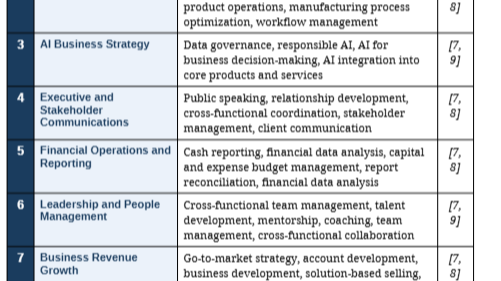
The MBA+™ and Certified MBA™ designations from the MBA Standards Board exist specifically to solve this problem. When you add these credentials to your LinkedIn profile, they come with embedded, machine-readable skills badges that AI hiring platforms, ATS software, and recruiter search tools can actually find. Skills like AI Fluency, Adaptive Leadership, Data-Driven Strategic Thinking, Ethical AI Governance, Digital Transformation, Financial Modeling, and others attached to a verified credential with a public verification URL that employers, job recruiters, and human resources can read and see.
This is the difference between a diploma hanging on your wall and a skills signal that recruiters see before they ever look at your LinkedIn profile or resume.
The Fog Is Real. Here Is What Collins Says to Do In It
After a cliff comes the fog. Collins is specific about this. Fog is not failure. It is not weakness. It is the disorienting liminal period between one identity and the next, when you know the old frame is gone but the new one has not yet come clear.
He observed something important about executives specifically. Leaders who had spent long careers in clarity, who always knew exactly who they were and what their role was, often found the fog intolerable. So they leaped. They took the next CEO role too quickly. They joined too many boards at once. They did anything to escape the discomfort of not knowing.
Leaping just to get out of the fog, Collins warns, can send you right over another cliff.
His recommended alternative is simplex stepping. You take the best step visible right in front of you, without needing to know your ultimate destination. Then from that new position, you find the next best step. Katharine Graham spent seven years simplex stepping her way into her identity as publisher of The Washington Post, one quiet decision at a time, before the Pentagon Papers gave her the chance to show the world what she had become.
For an MBA professional navigating the fog of AI disruption, a simplex step might look like completing the MBA™+ designation with the MBA Standards Board for an embedded skills badge for HR and others to find them on LinkedIn. Or earning a specialization badge in AI, Digital Finance, FinTech, or another of their 21 specializations. All while you still have a job. Getting your MBA+™ and Certified MBA™ credential embedded MBA skills badge before the cliff you can see coming actually arrives.
Alan Page started his law coursework while he was still starting in the NFL. He did not wait until the cliff to begin. That is the lesson that transfers directly to what MBA professionals need to do in 2026.
21 MBA Paths Back to Your Encoding
One of the most actionable ideas in Collins’ research is this. Your encoding, that deep signal of what you are built for, often becomes most visible when you line it up against specific domains where it could find expression.
The MBA Standards Board offers 21 career specialization tracks, each with embedded, machine-readable skill sets designed for the 2026 hiring reality. These are not theoretical concentrations. Each one is built around the specific skill tags that employer AI systems and recruiters are actively searching for to fill high paying job opportunities right now.
A few examples of where encoding and specialization might intersect for you:
If you have always been drawn to how organizations actually change rather than just how they are supposed to change, the Organizational Change and Agile Leadership specialization embeds skills in AI-Enhanced Change Impact Assessment, Psychological Safety for AI Experimentation, and Agentic Workflow Governance. Those are the terms that show up in searches from companies like Netflix, Spotify, and Capital One.
If your encoding pulls toward the ethics and governance side of AI, and a lot of MBA professionals have this pull without having named it, the AI Strategy and Innovation Management specialization includes Ethical AI Governance Frameworks, Responsible AI compliance, and Algorithmic Bias Mitigation Strategy. McKinsey, Google, and UnitedHealth are actively searching for these competencies at the MBA leadership level.
If your background has always been financial, but you feel the cliff of traditional finance roles being automated, Digital Finance and FinTech offers a path to skills in Blockchain Ecosystem Architecture, DeFi Risk Analysis, and Open Banking Compliance. These are skills that Stripe, JPMorgan Chase, and PayPal are searching for in candidates right now.
The specialization you choose is less about picking the hottest market trend and more about finding the version of your encoding that has a landing place in the new economy.
Collins would recognize this immediately. It is not about becoming someone different. It is about finding the frame where who you already are becomes visible and valuable in the world as it actually is now.
What This Looks Like Practically
The path from where you are to where Collins’ research points is shorter than it probably feels.
Adding MBA+™ to your LinkedIn name and Certified MBA™ to your About section takes about five minutes. Completing the qualification courses through Coursera, some of which take four to six hours total, can be done within a free trial window at no cost. Earning a specialization badge adds a machine-readable skills layer to your profile that hiring AI systems can actually find and surface to recruiters before a single human has looked at your name.
This is not about chasing credentials for vanity. It is about making sure that when the cliff arrives, and Collins’ decade of research says it will, your encoding is already visible to the people who are looking for exactly what skills you offer.
Because the fog after a cliff is shorter when you have prepared, before it hit. Alan Page knew that. Katharine Graham learned it. You do not have to wait to figure it out.
The MBA Standards Board exists to make sure you don’t lose any time before or after the cliff or are lost in the fog.
Professional Credentialing Organizations
with CE & Renewal Requirements
🎓 Business & MBA
· MBA Standards Board — Awards the Certified MBA™, MBA+™, and MBAe™ credentials to individuals who demonstrate a commitment to ongoing education, professional growth, and ethical leadership. Credential holders are required to take 6 CE credits every 2 years and a ethics review to keep certifications current.
🏦 Finance & Accounting
· AICPA — Awards the CPA (Certified Public Accountant). Requires state-specific CE (typically 40 hours/year or 80 hours every 2 years) and license renewal.
· CFA Institute — Awards the CFA (Chartered Financial Analyst). Has annual attestation and professional development requirements.
· IIA (Institute of Internal Auditors) — Awards the CIA (Certified Internal Auditor). Requires 40 CE hours every year.
📊 Project Management & Business
· PMI (Project Management Institute) — Awards the PMP (Project Management Professional). Requires 60 PDUs every 3 years.
· HRCI — Awards the PHR/SPHR (Professional in Human Resources). Requires 60 CE credits every 3 years.
⚖️ Legal & Compliance
· State Bar Associations — Govern attorney licensure. Most states require 12–15 CLE hours annually.
· ACFE — Awards the CFE (Certified Fraud Examiner). Requires 20 CE hours annually.
· IAPP — Awards the CIPP (Certified Info Privacy Professional). Requires 20 CE credits per 2-year cycle.
What unites all of these organizations is a shared professional standard: earn the credential through demonstrated competency, then sustain it through ongoing continuing education, ethics compliance, and periodic renewal, ensuring the designation remains meaningful and valuable over time. Many other licensed professions follow this same model, including social workers, therapists, real estate agents, and insurance agents, all of whom must meet state mandated continuing education requirements. The MBA Standards Board has emerged as the preeminent organization, bringing these same rigorous professional standards to MBA degree holders and professionals.
Learn more about the MBA+™ and Certified MBA™ designations and our 21 MBA Specializations at https://applymba.org/mba-specializations-2/ Questions? Connect with me directly at https://www.linkedin.com/in/cherylnunn/ and message me or email us at [email protected]