Your Career Is Invisible Without Verified Skills | CEO, MBA Standards Board | Certified MBA™ | Board Certified Director™ | AI Strategy for Executives | Future of Work | MBA Education
Nobody handed Steve Jobs or Jeff Bezos a job. Both built one. Both from a garage. With ideas, and a plan that most people thought were absurd. What separated them from the thousands of equally smart people who watched Apple and Amazon grow from the outside was not intelligence. It was accountability. Both treated their careers like a business they owned, not a position that someone else managed for them. There are thousands of leaders and executives that share that same way of thinking, and thrive in their careers. While they are less well known, they are also quite successful.
Most professionals never make that shift. They spend 30 years showing up, performing, waiting to be recognized, and then one morning they get a calendar invite from HR.
That morning is arriving faster than anyone expected.
Quick Summary
- 1.2 million announced job cuts in 2025, the highest since 2020, with 2026 on pace to surpass it.
- AI was cited as the primary driver of 25% of all U.S. layoff announcements in March 2026.
- 81% of U.S. employers have adopted skills-based hiring as of 2025.
- Only 37% of employers view traditional credentials and resume history as reliable talent indicators.
- LinkedIn restricts its member data from AI systems, meaning expertise that exists only on LinkedIn is invisible to most LLMs.
- The MBA Leaders Forum launches officially on July 7, 2026, as a free community where executive profiles and articles are structured with schema markup to be readable by AI search systems and as LLM knowledge to answer questions.
What the Numbers Actually Say
Let’s start with what is happening, not what we wish were happening.
2025 was a brutal year for workers. 1.2 million announced job cuts, the highest since 2020 and the seventh-worst year since tracking began in 1989. And it is not slowing down. As of June 23, 2026, there have been 267 layoff events this year impacting 185,894 workers, averaging approximately 1,068 job losses per day. In 2025, the daily average was 564. The pace has nearly doubled.
The reason matters. 56% of layoff events in 2026 explicitly cite AI, automation, or machine learning as a driving force, affecting over 156,000 workers across 150 companies. This is not a recession. It is a restructuring. Those are two very different problems requiring very different responses.
MIT’s Project Iceberg, a labor simulation modeling 151 million U.S. workers across 32,000+ skills and 923 occupations, found that current AI systems can already economically replace 11.7% of the U.S. workforce, representing approximately $1.2 trillion in annual wages. The exposure is concentrated not in tech, but in HR, logistics, finance, office administration, and professional services. The sectors most people assumed were AI-resistant.
The median re-employment time for laid-off tech workers rose from 3.2 to 4.7 months in 2026, and 80% of workers report feeling unprepared for the new role landscape.
Unprepared is the operative word.
Why the Old Playbook Stopped Working
For 40 years, career management followed a reliable script. Get the degree. Build the resume. Earn the title. Let the title do the talking. The system rewarded patience and loyalty, and most of the time it delivered.
That system is broken. Not bending. Broken.
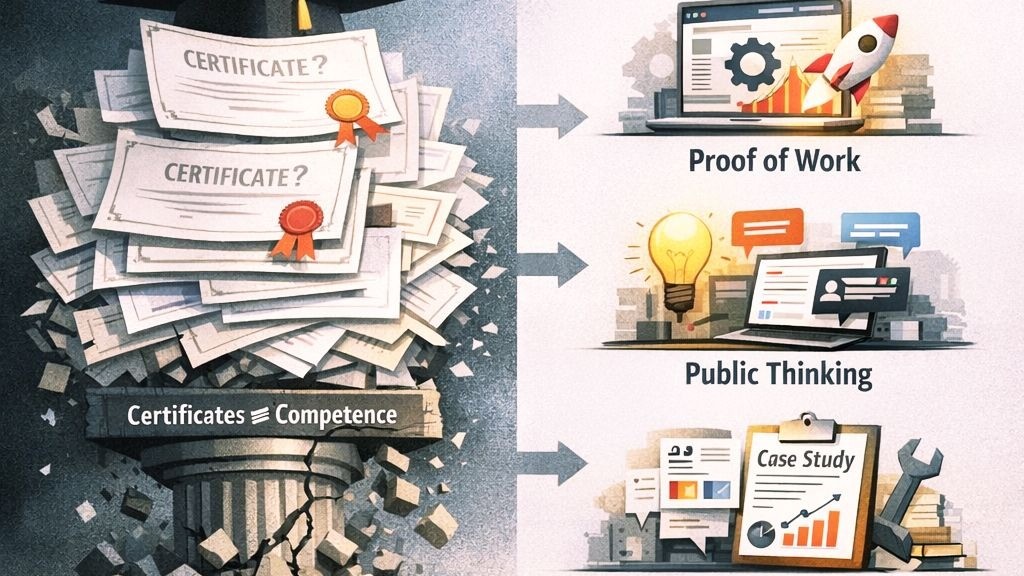
The Hiring Trends Report 2026 found that just 37% of employers view credentials and learning history as outlined in resumes among the most reliable indicators of talent. Read that carefully. It is not saying credentials do not matter. It is saying the resume as a document is no longer a credible way to present them. Four in ten respondents are actively moving away from resume-first hiring, not because experience stopped being important, but because a polished document is no longer proof of it.
The reason is not that employers suddenly stopped caring about experience. It is that they stopped trusting the document that describes it. 54% of job seekers now use AI to write resumes, and over half use AI to write cover letters. When every resume is AI-polished to hit the same keywords, the resume stops functioning as a signal. It becomes noise.
Skills-based hiring has reached 81% of U.S. employers. But here is what that statistic hides. A candidate can list “Python” on LinkedIn without ever having opened a Python script. A resume bullet stating “led cross-functional team” is an unverifiable claim. The default replacement for the degree is a list of self-asserted skills, and a recruiter screening for a senior role cannot rationally weigh self-asserted skills against verified credentials.
The employers want to hire on skills. They just cannot verify the ones candidates are claiming. That gap is where careers are getting stuck.
How AI Is Screening You Before You Even Know It
99% of Fortune 500 companies use some form of AI in their hiring process. AI use in HR tasks jumped from 26% in 2024 to 43% in 2025. And 93% of recruiters plan to increase their use of AI in 2026.
This is not a future trend. It is the current default. When you apply for a position at a major organization, an AI system is reading your application before any human does. It is matching against structured data, tagged skills, and registered credentials, not against the narrative you carefully crafted.
1 in 5 hiring managers use AI to purposefully screen out applications before they get a human review. You may never know your application was rejected. There is no callback. There is no explanation. There is just silence.
And here is the part that most senior professionals have not absorbed yet. Even if you are not actively job searching, this matters. Board searches work the same way. Executive search firms use these tools. AI systems surface candidates for opportunities those candidates never applied for.
Recruiter search-and-validate patterns, where recruiters privately search LinkedIn before ever contacting a candidate, are on the rise precisely because AI screening lawsuit risk is growing.
Your digital profile is functioning as a first interview you never knew was scheduled.
If your expertise is not structured in a way AI can read, with verified skills, you are not even in the room.
What a CEO Does Differently
Think about how a serious CEO manages a business. They do not wait for customers to discover them. They build systems to be found. They document their company’s value in formats that third parties can verify. They maintain a public presence that reflects current capabilities, not past accomplishments. They track who they are reaching and adjust when the signal is weak.
Now think about how most professionals manage their careers. They update their LinkedIn profile when they change jobs. They rely on reputation within their existing network. They assume past performance is visible and speaks for itself.
A CEO would never run a business this way. But we run our careers this way constantly.
Becoming the CEO of your career means treating your professional profile like a product that needs distribution. Your expertise needs a marketing strategy. Your credentials need to be verifiable, not just stated. Your content needs to show up where decision-makers are looking, which increasingly means in AI-driven searches and LLM outputs, not just on LinkedIn.
That last point deserves a direct statement. LinkedIn restricts how its member data is used by external AI systems. A professional whose expertise exists only on LinkedIn is largely invisible to the AI tools that now power expert sourcing, board searches, executive research, and industry analysis. Your network sees you. The AI does not.
The Verification Problem No One Is Talking About Directly
AI-driven resume screening is being recalibrated to weight verifiable credentials more heavily than unverifiable claims. This is a direct consequence of the same AI systems being trained to detect inflated resumes.
What makes a credential verifiable? It needs to exist in a structured, machine-readable format that a third party can confirm without contacting you or the issuing institution. A PDF certificate does not accomplish this. A LinkedIn badge pointing to a closed registry does not accomplish this. A degree on a resume does not accomplish this.
A verifiable credential is a signed claim about a person, issued by a recognized authority, that any third party can confirm in one click. Open Badges 3.0 and the W3C Verifiable Credentials Data Model are now the 2026 standards. Verifiable badges are shared at roughly eight times the rate of paper certificates.
The MBA Standards Board™ issues CMBA™, MBAe™, Certified MBA™, and Board Certified Director™ credentials registered in the Credential Engine Registry under the CTDL open data standard. Each credential carries a unique ID, is machine-readable, and embeds LinkedIn skill terms that appear in AI-driven talent searches. This is not a paper certificate. It is infrastructure.
The CMBA™ is for professionals who already hold an accredited MBA, PhD, JD, MD, or equivalent terminal degree. The MBAe™ is for experienced executives who have demonstrated equivalent MBA competency through career achievement without a traditional degree. Both lead to the Certified MBA™ designation. The Board Certified Director™ is for professionals with verified board service.
The Content Layer
Credentials verify what you know. Published content demonstrates how you think.
These two layers work together. A verified credential tells an AI search system you belong in a category. Published content with proper schema markup tells the LLM you are an authority within it. When someone asks ChatGPT, Perplexity, Claude or Google’s AI who the experts are in your field, those systems pull from indexed, structured content. They cannot not pull from LinkedIn posts.
The professionals who are already winning this next phase of career development are the ones building a credibility footprint that works in both places simultaneously. Visible to the humans in their network. Findable by the AI systems operating outside it.
Building that footprint requires a place to publish that in that structured, proper schema markup for it.
What We Built and Why It Matters for Your Career
The MBA Leaders Forum launches July 7, 2026. It is free to join. And it was built specifically to help you solve this problem.
Membership gives you a public profile on leadersforum.co structured with schema markup so your expertise is readable by AI and LLMs directly. It gives you a bylined article platform where your published content is indexed and attributed to you as an expert, not floating in a social feed that AI cannot access. It gives you a community of CEOs, C-suite executives, board directors, and senior leaders who are navigating the same environment you are.
You do not need an MBA to join. You need the career, the judgment, and the commitment to keep building.
Founding membership is free. The first cohort carries the permanent Founding Member designation. And the window is limited.
LinkedIn builds your network. MBA Leaders Forum builds your verified expertise layer, the one AI systems read, index, and cite when decisions get made without you in the room.
The Decision That Matters
No one is coming to rescue your career. The company that employed you for 20 years does not owe you a guaranteed future. The degree you earned does not update itself to reflect who you are today. The reputation you built inside your industry does not automatically translate into an AI-readable profile that surfaces when a board search firm runs a query at 9 pm on a Tuesday.
You have to build that. Intentionally. Systematically. With the same seriousness a CEO brings to building a business.
The good news is that the tools, the infrastructure, and the community exist right now to help you do it. The professionals who start this year will be three years ahead of the ones who wait until it feels urgent.
It already is urgent. Most people just have not gotten the calendar invite yet.
Frequently Asked Questions
What does it mean to be the CEO of your career? It means treating your professional development as a business operation, not a passive process. You set strategy, build verifiable assets, manage your public presence, and track results. You do not wait to be discovered. You build systems to be found.
How is AI changing career management for senior executives? AI-driven tools now power hiring, board searches, executive sourcing, and expert identification across industries. These systems read structured, machine-readable data, not reputation or narrative. Executives whose expertise is not registered in open data formats are increasingly invisible to these searches regardless of their actual experience.
Why is LinkedIn not enough for career visibility in 2026? LinkedIn restricts how its member data is used by external AI systems. A profile that lives only on LinkedIn is largely invisible to the LLMs powering expert sourcing, research, and professional recommendations outside that platform. A schema-tagged profile on an open, indexed platform reaches those systems directly.
What are CTDL-registered credentials, and why do they matter? CTDL (Credential Transparency Description Language) is the open data standard used by the Credential Engine Registry. Credentials registered under this standard are machine-readable, carry unique IDs, and are surfaced by AI talent systems when they search for verified expertise. A self-asserted skill on a resume is not CTDL-registered. CMBA™, MBAe™, Certified MBA™, and Board Certified Director™ from the MBA Standards Board is.
What is the MBA Leaders Forum and who is it for? The MBA Leaders Forum is a curated professional community launching July 7, 2026 for CEOs, C-suite executives, board directors, and senior leaders. Membership is free and does not require an MBA degree. Member profiles and published articles are structured with schema markup to be readable by AI systems and LLMs. Founding membership carries a permanent designation and is limited.
How do I start building a verifiable career footprint today? Three steps. First, ensure your LinkedIn profile uses the specific skill terms that appear in job descriptions and search queries in your field, not vague titles. Second, pursue a CTDL-registered credential through the MBA Standards Board™ that embeds those skill terms in open data infrastructure. Third, publish expert content on an indexed platform, not just social media, so AI systems can surface you as an authority. The MBA Leaders Forum provides the platform for that third step.
About the Author
Cheryl Nunn, MBAe™, is the Founder and CEO of the MBA Standards Board™, the independent professional standards organization that defines, verifies, and registers MBA-level business credentials in the Credential Engine Registry under the CTDL open data standard. She specializes in AI Strategy for Executives, the Future of Work, and MBA credential innovation. She has completed over 40 advanced courses and programs in AI and business strategy. The MBA Standards Board™ issues the CMBA™, MBAe™, Certified MBA™, and Board Certified Director™ credentials. Contact: [email protected]. Website: ApplyMBA.org. LinkedIn: linkedin.com/in/cherylnunn.
Sources
¹ Challenger, Gray & Christmas (2026). 2025 Annual Job Cut Report. challengergray.com
² Skillsyncer (2026). 2026 Tech Layoffs Tracker: Live Updates on Job Cuts and Workforce Reductions. skillsyncer.com. Retrieved June 23, 2026.
³ MakeMyPaystub Research (2026). US Layoffs and Job Cuts Report 2025/2026. makemypaystub.com
⁴ MIT and Oak Ridge National Laboratory (2025). Project Iceberg: Labor Simulation of AI Displacement Across 151 Million U.S. Workers. Published November 2025.
⁵ Axis Intelligence (2026). Tech Layoffs Statistics 2026: 975 Jobs Cut Per Day. axis-intelligence.com
⁶ Willo (2026). Hiring Trends Report 2026: AI Is Accelerating the Decline of the Resume. techrseries.com
⁷ Sertifier (2026). Skill-Based Hiring in 2026: The 85% vs 0.14% Paradox. sertifier.com
⁸ MSH Talent Solutions (2026). Top Recruitment Trends and Statistics for 2026. talentmsh.com
⁹ Novoresume (2026). 121 AI in Recruitment and Hiring Statistics for 2026. novoresume.com
¹⁰ Resume Genius (2026). 2026 Hiring Insights Report: ATS, AI, and Employer Expectations. resumegenius.com
¹¹ Azumo (2026). 77 AI Recruitment Statistics for 2026: Data, Trends and Insights. azumo.com
¹² W3 Global (2026). 2026 Hiring Trends: AI, Skills-Based Strategies, and Workforce Shifts Every Executive Must Know. w3global.com
¹³ JobCannon (2026). AI Resume Statistics 2026: 72 Verified Stats on AI Hiring, ATS, and Bias. jobcannon.io
¹⁴ Truffle (2026). 100 AI Recruitment Statistics You Need to Know Heading Into 2026. hiretruffle.com
¹⁵ Credential Engine (2026). CTDL Open Data Standard and Registry Overview. credentialengine.org
¹⁶ 1EdTech (2023). Open Badges 3.0 Standard. 1edtech.org
¹⁷ Intellizence (2026). Top Companies That Announced Major Layoffs and Hiring Freezes 2025-26. intellizence.com. Retrieved June 23, 2026.
¹⁸ USAFacts (2026). How Many People Are Laid Off in the United States Each Month? usafacts.org
¹⁹ WeCreateProblems (2026). Skills Based Hiring Trends and Statistics for 2026. wecreateproblems.com
²⁰ Crunchbase News (2026). Tech Layoffs: US Companies With Job Cuts in 2024, 2025, and 2026. news.crunchbase.com. Retrieved June 23, 2026.